As we approach the end of the year it's normal to reach for the crystal ball and peer into the future. This is particularly the case as there's so much at stake, and so much that might - or in the case of the RBA's stance on interest rates...
Read more...
6 Dec 2024 - Hedge Clippings | 06 December 2024
By: FundMonitors.com
Hedge Clippings | 06 December 2024
As we approach the end of the year it's normal to reach for the crystal ball and peer into the future. This is particularly the case as there's so much at stake, and so much that might - or in the case of the RBA's stance on interest rates - might not change.
Politically, the potential for change is already in place, with Donald Trump returning to the inauguration stage on the 20th of January. Although we might know the presidential inauguration date, and have been given a pretty clear outline of his policies, big question marks hang over both their effect on the US economy, and the reaction to them from the rest of the world - particularly from China which is already facing a further slowdown - and politically from Russia and Israel. More recently, there's been turmoil in France, and back in Australia, there's an election due by May, which it seems could go either way.
However, you can't look into the crystal ball without also looking in the rear-view mirror. This week's PinPoint Macro Analytics article (see link to full article below), summarises Australia's economy over the past year as a "curate's egg" - partly good and partly bad. Inflation improved, but not enough to enable the RBA to move off their "narrow path" while GDP growth slowed to just 0.3% in the September quarter, and 0.8% over 12 months.
Of course the original "curate's egg" was all bad - it just depended on which side of the table - the Bishop's or his unfortunate Curate's - one was sitting. So it is with Australia's economy, particularly if you're struggling with the cost of living, or with an oversized mortgage.
Inflation in Australia only improved thanks to government support for electricity prices, while GDP growth only stayed positive thanks to government support. Dr. Chalmers would argue that's what his priorities should be. Meanwhile private demand through household consumption and business investment contributed nothing to September's insipid GDP growth rate.
On the positive side, Australia's employment market remained strong, with unemployment hovering around 4.0%. Ironically, had this not been the case, the RBA might have moved to cut rates, a move some economists are now calling for, even if they're not expecting it to happen pre-election. Depending on how you look at it, the RBA has navigated the inflation cycle well, having not raised rates as much as their offshore counterparts, and as a result haven't moved to cut them either.
Looking forward to 2025, PinPoint's research sees the global outlook remaining somewhat uninspiring, with the IMF describing the situation as "underwhelming". Still, while risks continue to skew towards the downside, recession fears have not made their way into most credible forecasts.
PinPoint suggests that inflation pressures will ease globally, allowing central banks to continue reducing rates. In Australia, they note that the consensus points to a modest improvement in economic performance for 2025, but one that remains below the nation's growth potential.
Encouraging consumer spending and overcoming the Reserve Bank of Australia's hesitation on rate cuts are, in their view, crucial to supporting this growth PinPoint's analysis also highlights challenges in the labour market, where employment has remained unexpectedly resilient, and as noted above, an inflation rate above the RBA's 2-3% comfort zone. Internationally, the report points to persistent economic and geopolitical concerns, from China's struggling property market to the ongoing impact of the Russia-Ukraine conflict.
Below is Part 1 of PinPoint's full "Risks and Issues in 2025" looks at the outlook for Australia's economy against the global backdrop. Part 2, which looks at domestic risks and issues, will be available in next week's Hedge Clippings.
17 Dec 2024Performance Report: Cyan C3G FundFundMonitors.com
The Cyan C3G Fund rose by +3.41% in November, an outperformance of +2.09% compared with the ASX Small Ordinaries Total Return benchmark which rose by +1.32%. Top contributors...
Read more
17 Dec 2024 - Performance Report: Cyan C3G Fund
By: FundMonitors.com
[Current Manager Report if available]
17 Dec 2024Performance Report: Glenmore Australian Equities...FundMonitors.comGlenmore Australian Equities Fund, Australian Equities, ASX200 Accumulation Index, A
The Glenmore Australian Equities Fund rose by +5.14% in November, outperforming the ASX 200 Total Return benchmark by +1.35%. Since inception in June 2017, the fund has...
Read more
17 Dec 2024 - Performance Report: Glenmore Australian Equities Fund
By: FundMonitors.comGlenmore Australian Equities Fund, Australian Equities, ASX200 Accumulation Index, A
[Current Manager Report if available]
17 Dec 2024Proprietary Data - Strategic AI AdvantageInsync Fund Managers
Proprietary data sets provide businesses with competitive advantages due to their uniqueness, quality and relevance. They are often more specific, accurate, and tailored to a...
Read more
17 Dec 2024 - Proprietary Data - Strategic AI Advantage
By: Insync Fund Managers
Proprietary Data - Strategic AI Advantage
Insync Fund Managers
December 2024
Proprietary data sets provide businesses with competitive advantages due to their uniqueness, quality and relevance. They are often more specific, accurate, and tailored to a company's particular needs or industry, providing a rich data source for AI algorithms.
RELX Plc is a global provider of information-based analytics and decision tools providing products that help researchers advance scientific knowledge across medical, legal, financial services, and government sectors.
They recently showcased their Legal division's advancements highlighting cutting-edge AI-enabled tools like Lexis+ and its next-generation AI assistant, Protégé. This division underwent a remarkable transformation, shifting from print and basic electronic reference services to advanced analytics and decision-making platforms. Growth rates have accelerated by 14%, with the division now targeting an 8% growth rate by 2025.
RELX's competitive advantage lies in its extensive proprietary datasets, leading brands, and a robust installed user base. Analysts increasingly recognize RELX as an AI beneficiary.
By integrating RELX's vast 100+ billion document datasets with clients' internal knowledge, their AI assistant addresses legal professionals' top demands, enhancing productivity. This unlocks a 20% total addressable market (TAM) expansion.
At Insync, we see RELX as a prime example of technology driving structural growth. The company's accelerating growth and discounted valuation relative to peers underscore our conviction, making RELX one of our key holdings.
Disclaimer
Equity Trustees Limited ("EQT") (ABN 46 004 031 298), AFSL 240975, is the Responsible Entity for the Insync Global Quality Fund and the Insync Global Capital Aware Fund. EQT is a subsidiary of EQT Holdings Limited (ABN 22 607 797 615), a publicly listed company on the Australian Securities Exchange (ASX: EQT). This information has been prepared by Insync Funds Management Pty Ltd (ABN 29 125 092 677, AFSL 322891) ("Insync"), to provide you with general information only. In preparing this information, we did not take into account the investment objectives, financial situation or particular needs of any particular person. It is not intended to take the place of professional advice and you should not take action on specific issues in reliance on this information. Neither Insync, EQT nor any of its related parties, their employees or directors, provide and warranty of accuracy or reliability in relation to such information or accepts any liability to any person who relies on it. Past performance should not be taken as an indicator of future performance. You should obtain a copy of the Product Disclosure Statement before making a decision about whether to invest in this product.
16 Dec 2024Performance Report: Bennelong Emerging Companies...FundMonitors.com
The Bennelong Emerging Companies Fund rose by +6.43% in November, outperforming the ASX 200 Total Return benchmark by +2.64%. Since inception in November 2017, the fund has...
Read more
16 Dec 2024 - Performance Report: Bennelong Emerging Companies Fund
By: FundMonitors.com
[Current Manager Report if available]
16 Dec 2024Investment Perspectives: Why a Trump presidency...Quay Global Investors
Last month, US voters re-elected Donald Trump for a second term as US president. As a result, market enthusiasm and expectations are high. An immediate rally in US equities...
Read more
16 Dec 2024 - Investment Perspectives: Why a Trump presidency could be deflationary
13 Dec 2024Performance Report: 4D Global Infrastructure Fund...FundMonitors.com
The 4D Global Infrastructure Fund (Unhedged) rose by +8.1% over the past 12 months. Since inception in March 2016, the fund has returned +9.03% per annum, a difference of...
Read more
13 Dec 2024 - Performance Report: 4D Global Infrastructure Fund (Unhedged)
By: FundMonitors.com
[Current Manager Report if available]
13 Dec 2024Performance Report: Argonaut Natural Resources...FundMonitors.com
The Argonaut Natural Resources Fund returned -2.7% in November, outperforming the S&P/ASX 300 Resources TR benchmark by +0.71%. Since inception in January 2020, the fund has...
Read more
13 Dec 2024 - Performance Report: Argonaut Natural Resources Fund
By: FundMonitors.com
[Current Manager Report if available]
13 Dec 2024Performance Report: Bennelong Twenty20 Australian...FundMonitors.com
The Bennelong Twenty20 Australian Equities Fund rose by +4.49% in November, outperforming the ASX 200 Total Return benchmark by +0.7%. Since inception in November 2009, the...
Read more
13 Dec 2024 - Performance Report: Bennelong Twenty20 Australian Equities Fund
By: FundMonitors.com
[Current Manager Report if available]
13 Dec 2024Risks & Issues in 2025 - Part 2PinPoint Macro Analytics
Part 2 of Risks & Issues in 2025 considers the implications of the global backdrop discussed in Part 1 for Australia - as well as some home-grown influences.
Read more
13 Dec 2024 - Risks & Issues in 2025 - Part 2
By: PinPoint Macro Analytics
13 Dec 2024Trump trade 2.0 - Who is going to buy all this...Challenger Investment Management
In 2016 the election of Donald Trump as president of the United States caused an initial panic in markets with S&P500 futures plunging over 5% as his shock win became more...
Read more
13 Dec 2024 - Trump trade 2.0 - Who is going to buy all this stuff?
By: Challenger Investment Management
Trump trade 2.0 - Who is going to buy all this stuff?
Challenger Investment Management
November 2024
In 2016 the election of Donald Trump as president of the United States caused an initial panic in markets with S&P500 futures plunging over 5% as his shock win became more likely. Wall Street had favoured Clinton, fearing Trump's positions on trade. Markets settled down on the US open as investor fears of the most extreme policies abated.
Fast forward to 2024 and Trump has returned with Republicans controlling the House and Senate on the back of a similar policy agenda centred around trade and immigration. This time however equities rallied prior to the election on expectation of a Trump win and post the election once his victory was confirmed.
The key difference between 2016 and 2024 is the state of the US balance sheet. In 2016 the debt to GDP ratio was 105%, peaking at 132% in the second quarter of 2020 and stands at 120% today. The deficit in 2016 was 3% of GDP. In 2023 it was over 6% and according to Deutsche Bank, will average around 7% over the Trump presidency, higher than the 6% average projected by the Congressional Budget Office.
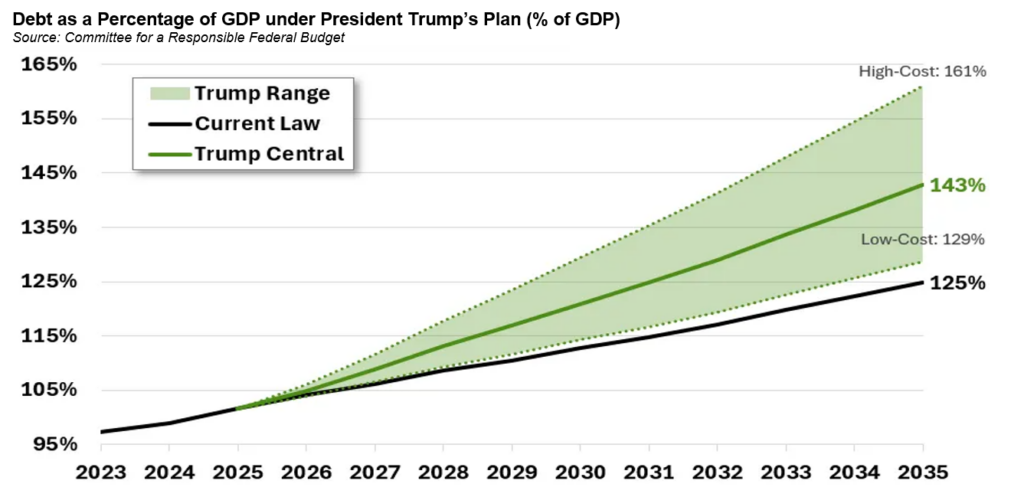
Prior to the election the bipartisan Committee for a Responsible Federal Budget estimated that a Trump presidency would result in an 18% increase in the public debt to GDP ratio relative to the current trajectory (note the below chart shows the debt held by the public and excludes debt held by federal trust funds and other government accounts).
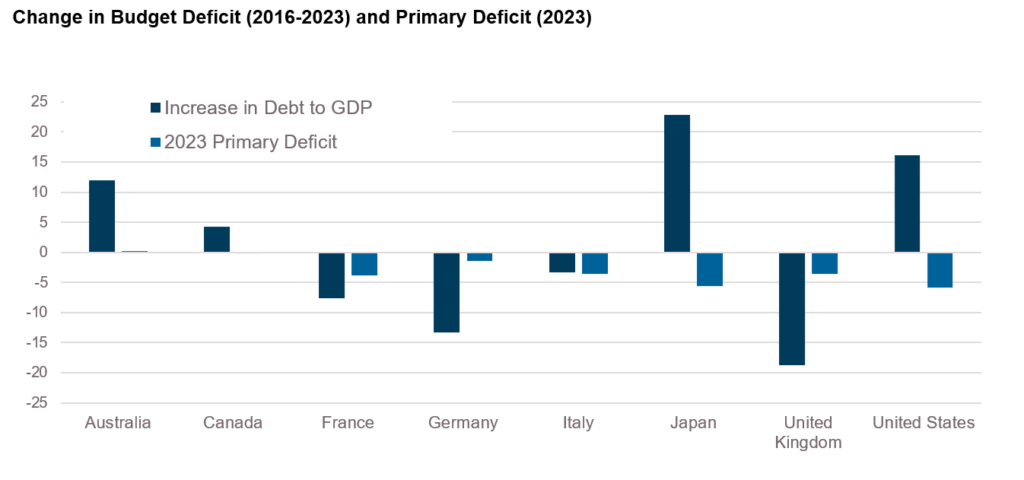
The problem for the United States is not so much the change in the deficit but that it is so much more than those observed by its peers. From 2016 to 2023, the debt to GDP in the United States increased by more than 15%, second most of the peer group above. Perhaps even more concerningly, the primary deficit in 2023 was the worst amongst these nations suggesting, if the above projections hold, the United States debt to GDP ratio will be the second highest amongst developed nations only trailing Japan.
Adding to the supply story is the demand side of the equation. During periods of quantitative easing the Federal Reserve is a classic example of a price insensitive buyer. However, since mid-2022 they have been a price insensitive net seller (effectively, by not reinvesting principal repayments) with the balance sheet down by around US$0.75 trillion to US$7 trillion over the last 12 months. The Fed is currently allowing up to US$25 billion in Treasuries and up to US$35 billion in MBS to mature without reinvestment monthly which could result in another $0.7 trillion reduction over 2025 i.e. a quantitative tightening period. Contrast to 2016 when there was virtually no change to the Fed balance sheet.
With the Federal Reserve out of the equation the marginal buyers over the past 12 months have been largely price sensitive buyers; money market funds (up US$1.2 trillion), private foreigners (up US$0.5 trillion) and households and nonprofits (up $0.35 trillion). Commercial banks, a price insensitive buyer has increased their holdings, up US$0.15 trillion in the 12 months to 30 June 2024.
With supply increasing and the marginal buyer of treasuries transitioning from a price insensitive one to a price sensitive one the bias would seem to be for yields to move higher. Of course, the Federal Reserve remains the buyer of last resort but in all likelihood will only step in where absolutely necessary. Markets are now pricing the Fed Funds rate declining to around 3.75% by early 2026, a full 100 basis points higher than what was priced only two months ago.
To be clear our view is not that Trump's election and the Republican sweep of the House and Senate will result in systemic issues within the treasury market in the United States. We're also not suggesting that treasuries now entail some level of credit risk given the increases in the debt to GDP ratio that we expect over the coming years. We would argue that tail risks have increased given the unpredictability of this administration compared to the more orthodox Biden administration which is a topic worthy of discussion (and something we'll get to in a future piece) but our central position is that a Trump presidency cements the higher for longer thesis.
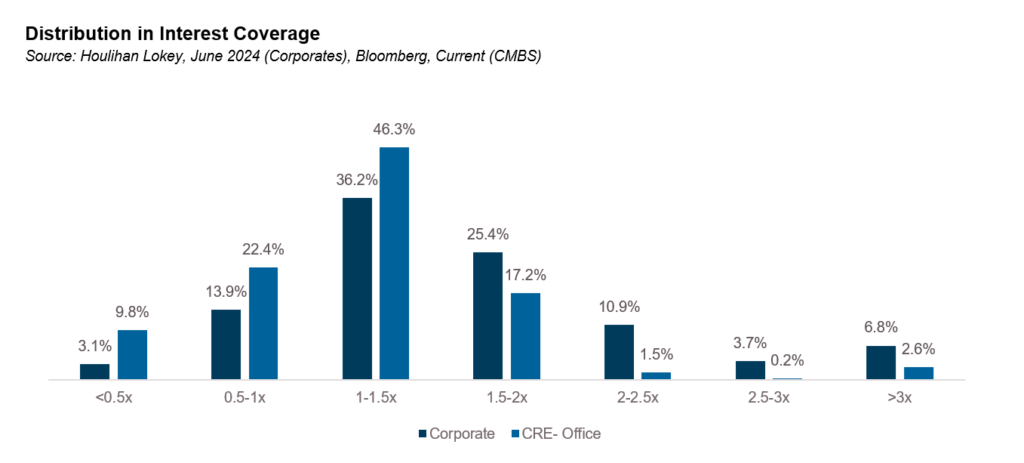
So, what does higher for longer mean for credit? For the most part, corporate credit has been resilient to higher interest rates and has weathered the hiking cycle well with higher earnings muting the impact of higher interest rates. For the S&P500, EBITDA has increased by 15% from the point at which interest rates started increasing. For middle market borrowers, the effect has been even more pronounced with earnings increasing by around 20% over the corresponding period. Interest coverage has stabilised at around 1.5 times with around 15% of borrowers with coverage of less than 1 times. This will improve as interest rates decline.
The problem child for credit markets remains commercial real estate markets which is most acutely impacted by higher interest rates. A Bloomberg search of adjustable rate office loans contained in CMBS transactions shows that over three quarters currently have serviceability ratios of less than 1.5 times with one third below 1 time.
It's ironic given the Trump family made their name in commercial real estate that the sector we expect to be most impacted by his presidency is CRE but it is the one that is more leveraged to interest rates. And while wider equity markets have rallied strongly to the new administration, mortgage finance REITs are flat for the month.
Author: Pete Robinson | Head of Investment Strategy - Fixed Income
Disclaimer: The information contained in this publication has been prepared solely for solely for the addressee. The information has been prepared on the basis that the Client is a wholesale client within the meaning of the Corporations Act 2001 (Cth), is general in nature and is not intended to constitute advice or a securities recommendation. It should be regarded as general information only rather than advice. Because of that, the Client should, before acting on any such information, consider its appropriateness, having regard to the Client's objectives, financial situation and needs. Any information provided or conclusions made in this report, whether express or implied, do not take into account the investment objectives, financial situation and particular needs of the Client. Past performance is not a guide to future performance. Neither Fidante Partners Limited ABN 94 002 895 592 AFSL 234 668 (Fidante Partners) nor any other person guarantees the repayment of capital or any particular rate of return of the Client portfolio. Except to the extent prohibited by statute, Fidante Partners or any director, officer, employee or agent of Fidante Partners, do not accept any liability (whether in negligence or otherwise) for any errors or omissions contained in this report.
Online Applicatons
Free, simple and secure
Olivia123 - the fast simple and secure online alternative to completing paper based application forms.
"I've been subscribing to AFM for over two years and love it. The ability to compare funds, do in-depth research and gain data-driven insights into performance metrics and performance rankings in a highly visual way is second to none. Highly recommended."
~ James Waggett,
Managing Director of Waggett Wealth Advice Ltd